

Prehistoric Fossil Reveals Much About Bird-Brained Creatures
November 22, 2024

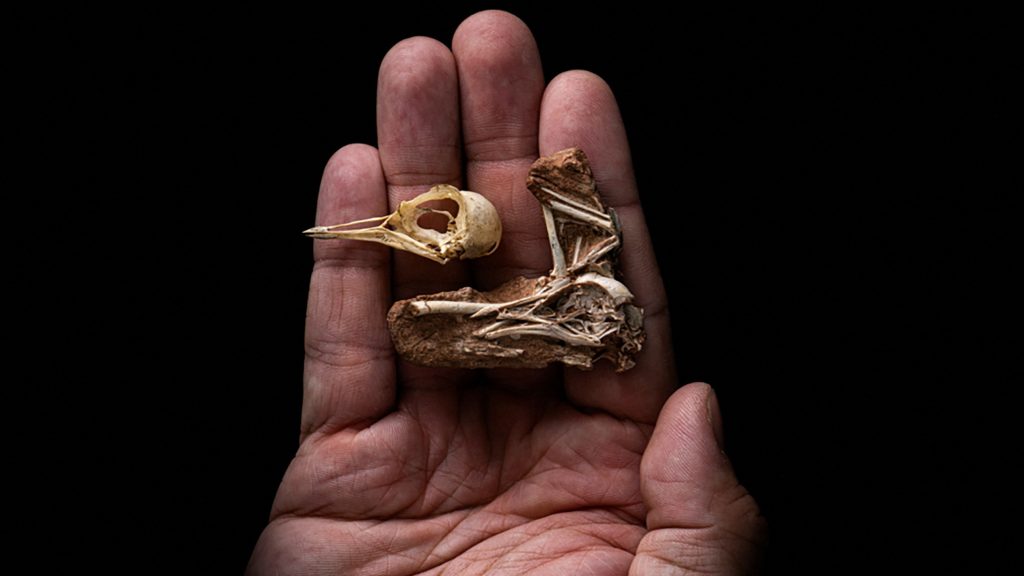
Feathered birds of today’s world descended from the same ancient creatures as the dinosaurs. But studying their evolution has proven hard for scientists. The birds are small and fragile. So finding bones and other intact parts from millions of years ago has been a challenge.
“They're (lovely), but they're all like roadkill,” expert Luis Chiappe told NPR. “They're all flattened and there are aspects that you're never going to be able to (study) from those fossils.” Chiappe is a paleontologist. He's also the curator at the Natural History Museum of Los Angeles County.
A newly found bird-like fossil may change things. It was found incredibly intact. Scientists named the new species Navaornis hestiae. It's described in the journal Nature.
William Nava found the fossil in São Paulo state. This happened in 2016. Nava is a paleontologist in Brazil. Researchers say the fossil dates to roughly 80 million years ago. That's when the oldest bird-like creatures flew above the dinosaurs. The mass extinction of dinosaurs is believed to have occurred about 10 million to 20 million years ago.
The fossil shows a creature about the size of a pigeon. It would've been feathered and a flier, Chiappe said. He added that it very closely looked like modern birds with pointed claws sticking out of its wings.
Researchers performed a CT scan on the creature’s skull. They used it to create what they believe is a good replication of its brain. They say that, unlike modern birds, the cerebellum part of its brain is not very developed. That section helps birds maintain balance and flight. However, the cerebrum, which is linked to higher level cognition, was sizable.
“It tells us (about) these sorts of transitional birds,” expert Daniel Field told NPR. Field's a vertebrate biologist at the University of Cambridge.
Reflect: What do you think makes discovering ancient creatures exciting or important?
Photo of the skeletal remains of the starling-sized bird Navaornis hestiae, from Reuters.
News brought to you by 
Read More News Stories Today!