
People-Pig Partnership Produces Profound Progress in Porker Pates
February 14, 2025

What a difference 100 years can make, especially in the profiles of pigs.
A German research team found pig skulls from 100 years ago look much different than those of today’s farm dwellers. The team argues it's proof that humans have the power to affect evolution.
"Charles Darwin assumed that long periods of time — millions of years — are required for major changes to take place." Frank Steinheimer told Phys.org. He's the head of the Central Repository of Natural Science Collections at Martin Luther University. He went on to note that his team's findings prove that humans can speed up evolution "through selective breeding."
Steinheimer co-authored a study about the topic published this month in the journal Royal Society Open Science. It studied 3D scans of 135 pig skulls from the early 1900s. They chose two domesticated species to study. They compared those skulls to X-rays of modern pig skulls. Wild boars were used as a control group.
The team found that modern pigs have much shorter, flatter snouts than pigs 100 years ago. They also have less curved foreheads. And wild boars? They showed almost no changes since the early 1900s. The findings shocked Steinheimer’s team.
"We didn't expect such pronounced differences to appear within a span of only 100 years," study co-author Renate Schafberg said. The team also noted that the changes might not be on purpose. After all, a pig’s value doesn’t increase based on the changes observed. That means breeders had no reason to pick pigs with those traits. They hypothesize it could be a byproduct of feeding the pigs pellets high in protein, rather than their more grain-based diets from a hundred years ago.
Reflect: What is the most surprising way you think an animal has changed because of humans?
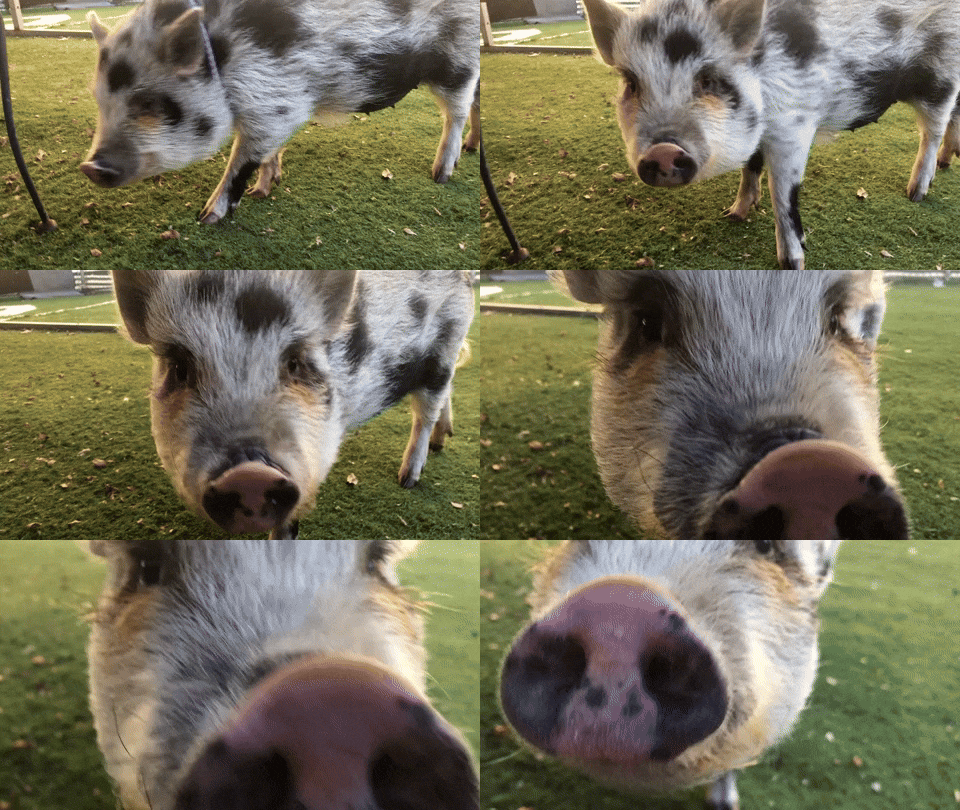
Gif of a pig from GIPHY.
News brought to you by 
Read More News Stories Today!