
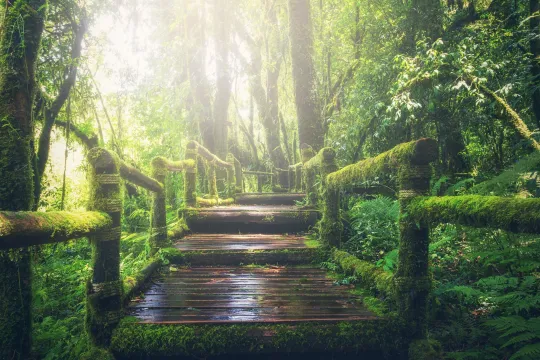
How Rainforests are Formed, and How They are Being Destroyed
Provided by: Global Forest Watch|Published on: January 17, 2023|Last updated: July 16, 2026
Grades: 6, 7, 8, 9, 10, 11, 12
Type: Articles/Websites
Subjects: Biology, Geography
Authors: Global Forest Watch, Sarah Ruiz
Location: Earth
This resource has been reviewed by SubjectToClimate's climate scientists and verified for scientific accuracy and up-to-date information. Learn about our review process →
This resource has been reviewed by SubjectToClimate's climate scientists and verified for scientific accuracy and up-to-date information. Learn about our review process →
Synopsis
- This captivating article describes how rainforests are formed and destroyed.
- Interactive maps are embedded throughout the article to visualize tree cover, tree cover loss, carbon release from clear-cutting forests, and fire risk.
Teaching Materials
Positives
- The article is easy to read, interspaced with illustrations, pictures, and interactive maps.
- The interactive maps can be zoomed in and out to get analysis by country or by continent.
Additional Prerequisites
- Students may need support navigating and interpreting the embedded maps.
Differentiation
- As an extension of this activity, educators could encourage students to research more about rainforests and how they are connected to climate change.
- Biology classes could further discuss rainforest ecosystems and how they are being harmed by rainforest destruction.
The resource will enable students to understand the different layers of tropical rainforest and the interactions within the forest ecosystem. It is suitable to equip students with the skills to map logging routes to understand the flow and intensity of logging in order to proffer solutions to indiscriminate logging within the forest and the surrounding forests. This resource is recommended for teaching.
Teaching Tips
Standards
Resource Type and Format
Scientist Reviewed
This resource has been reviewed by SubjectToClimate's climate scientists and verified for scientific accuracy and up-to-date information. Our review process ensures that every resource in our library reflects the current state of climate science.
Learn about our review process →