
Giants of the Sea Math Lesson
Provided by: American Museum of Natural History|Published on: May 24, 2024|Last updated: July 16, 2026
Grades: 9, 10, 11, 12
Type: Lesson Plans
Subjects: Biology, English Language Arts, Mathematics
Authors: American Museum of Natural History
Location: North America > United States > California
This resource has been reviewed by SubjectToClimate's climate scientists and verified for scientific accuracy and up-to-date information. Learn about our review process →
This resource has been reviewed by SubjectToClimate's climate scientists and verified for scientific accuracy and up-to-date information. Learn about our review process →
Synopsis
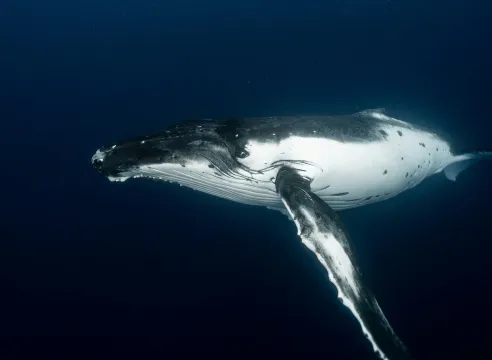
- In this four-part lesson about whales, students will watch videos, read essays, and analyze data to learn that whales are the largest mammals on Earth, how scientists research their daily patterns, and how human activity endangers whales.
- The videos and readings follow a team of researchers from Stanford University’s Hopkins Marine Station in Pacific Grove, California that provide data for the students to analyze in the activity.
Teaching Materials
Positives
- The video demonstrating the process of tagging whales illustrates just how exciting the operation is.
- Students will benefit from seeing an example of oceanographers who are passionate about their work.
Additional Prerequisites
- Students should understand volume, surface area, and exponential increases. They will also need to know how to read graphs.
- One of the readings references a case study, “Little Robots That Go with the Flow,” from a preceding lesson. Students do not need to have read this case study to understand the reading.
- Some of the vocabulary is complex and students may need some terms defined before they read.
Differentiation
- Teachers can use the readings for a flipped classroom model, introducing the reading with the video in class, assigning the reading as homework, and discussing the Stop and Think questions and the data in class the next day.
- After completing Part 4, science teachers can make connections by having students research how human activity has contributed to the presence of microplastics in the ocean and how this will impact marine life.
- Students interested in pursuing a career in oceanography can research local education opportunities to help them achieve that goal.
- Math classes that do not have time to read long articles can omit these and focus on the videos and the data.
- Though this is a math lesson, language arts and science classes can find value in the readings, videos, and data.
- Older or more advanced readers can read the Teacher Version of the readings.
- After completing the lesson, students can research the impact of climate change on krill, copepods, and phytoplankton and discuss how this may affect whales.
There is not a lot of climate science in this resource, as it primarily focuses on Blue Whales. But Part 4 of this resource discusses how climate change affects ocean temperatures, which may alter their primary food source, krill. This resource is recommended for teaching.
Teaching Tips
Standards
Resource Type and Format
Scientist Reviewed
This resource has been reviewed by SubjectToClimate's climate scientists and verified for scientific accuracy and up-to-date information. Our review process ensures that every resource in our library reflects the current state of climate science.
Learn about our review process →